For seven thinkers, one bottle, and a cocktail napkin
May 2026
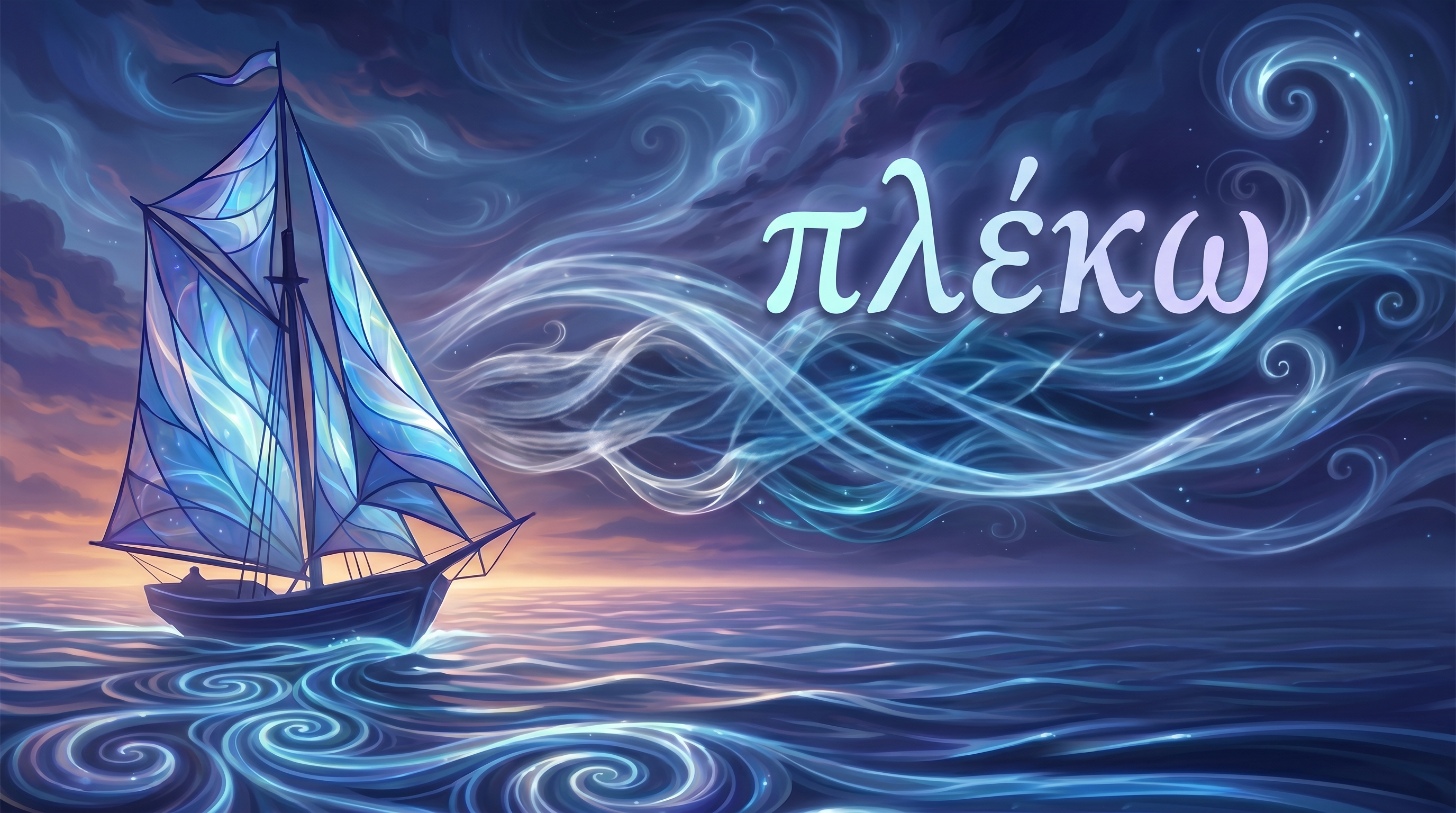
The skit opens with πλέκω (I braid) on the sailboat image — a mystery, a voice, an unnamed hand. It closes with ἡ φύσις πλέκει (nature braids) — the answer, the revelation, the thesis. The entire skit is the journey from I to nature. From the personal to the universal. From one voice braiding to the recognition that braiding is what everything does.
The bar at the Athenaeum, California Institute of Technology, Pasadena. Wood-paneled walls, leather chairs, framed portraits of Nobel laureates. A well-stocked bar with a brass rail. May 11th — Richard Feynman's birthday.
| Character | Full Name |
|---|---|
| Feynman | Richard Phillips Feynman |
| Ockham | William of Ockham (no surname — medieval naming; sometimes written Occam) |
| Weyl | Hermann Klaus Hugo Weyl |
| Kolmogorov | Andrey Nikolaevich Kolmogorov |
| Rissanen | Jorma Johannes Rissanen |
| Koopman | Bernard Osgood Koopman |
| Von Neumann | John von Neumann (born János Lajos Neumann von Margitta; known to friends as Johnny) |
| Ken Mendoza | Kenneth A Mendoza |
(The bar is empty except for FEYNMAN, who is arranging bottles and humming. A door opens. OCKHAM enters, looks around with deep suspicion.)
Feynman: Welcome to the Athenaeum! You must be Father William.
Ockham: I am William of Ockham. I was told there would be a discussion of natural philosophy.
Feynman: There will be. There'll also be drinks. What can I get you?
Ockham: (looking at the cocktail menu, which is extensive) What is a… "Pasadena Sunset"?
Feynman: Orange juice, vodka, grenadine, triple sec, pineapple, a cherry, and a little umbrella.
Ockham: That is six unnecessary ingredients. I will have wine. One kind. Red.
Feynman: A man of principle. (pours) Red it is.
(The door opens. WEYL enters, precise and unhurried. He surveys the room, notices the bottles behind the bar are not arranged by any discernible symmetry, and visibly restrains himself.)
Feynman: Hermann! Come in, come in.
Weyl: Richard. Thank you for the invitation.
(He sits, places his book on the bar, and absently rotates a cocktail napkin until its edges are parallel with the bar rail.)
A gin and tonic, if you please. The proportions matter — two to one, gin to tonic. Not the reverse.
Feynman: A man who respects ratios.
Weyl: A man who respects invariants. The ratio is what survives the choice of glass.
(OCKHAM looks at WEYL with sudden interest.)
(The door opens. KOLMOGOROV enters. He is wearing a heavy coat. He removes it, folds it with military precision, hangs it on a hook, and sits at the bar. He examines the wallpaper.)
Feynman: Andrey! What'll it be?
Kolmogorov: Vodka.
Feynman: Any particular —
Kolmogorov: Vodka.
Feynman: (pouring) Done. Welcome to California.
Kolmogorov: (still examining the wallpaper) Your wallpaper has a period of fourteen inches. The pattern could be described in eleven bytes. Wasteful repetition.
Feynman: I'll let the decorator know.
(The door opens one final time. RISSANEN enters. He is the quietest arrival — he is simply there, sitting at the end of the bar, before anyone fully registers his entrance. He has ordered nothing.)
Feynman: Jorma?
Rissanen: Single malt. Neat. Whichever bottle requires the least decision on your part.
Feynman: (grabs the nearest bottle, pours) Man after my own heart.
(RISSANEN nods once. Sips. Says nothing.)
Feynman: (looking at all four) Alright. You're all here. Thank you for coming. Especially you, Father — I know the commute was murder.
Ockham: Seven centuries. I have had worse journeys. I once fled Avignon in the night with nothing but a stolen horse and the Minister General of my order.
Feynman: I once drove from Ithaca to Pasadena in a van with a broken heater. I think we're even.
Feynman: So. Cards on the table. It's my birthday, and I want a present. Here's what I want: I want somebody to help me crack the Theory of Everything.
(OCKHAM sips his wine. WEYL adjusts a napkin. KOLMOGOROV says nothing. RISSANEN says nothing.)
Feynman: Physics has a problem. We've got two theories — quantum mechanics and general relativity — and they're both beautiful and they both work and they do not talk to each other. So everybody's been trying to glue them together. More dimensions. More particles. More symmetries. More math. More more more. And none of it works. You know what I think? I think we need less. So I invited the four greatest minds in the history of less. And I want to know: what does "less" actually mean?
(He looks at OCKHAM.)
Feynman: Father. You're the original. You go first.
Ockham: (setting down his wine) Very well. My principle is this: Numquam ponenda est pluralitas sine necessitate. Plurality is not to be posited without necessity. If two explanations account for the same observations, and one requires fewer entities, the one with fewer entities is to be preferred. Not because it is true — truth is God's domain — but because what is unnecessary is, by definition, not needed.
Feynman: Okay. So apply it.
Ockham: Your colleagues invent invisible entities. Extra dimensions — six of them? Seven? Curled up too small to see? By what necessity? Explain to me the observation that demands a seventh dimension.
Feynman: They're needed to make the math consistent.
Ockham: The math. Not the world. You are adding entities to save your equations, not to account for what you see. This is precisely — precisely — what my principle forbids.
Feynman: Okay, but here's where I get stuck with you, Father. Your razor tells me to cut. It doesn't tell me what to keep. I start with two theories. I start cutting. When do I stop? How do I know when I've cut enough? How do I know I haven't cut something I needed?
(OCKHAM opens his mouth. Closes it. Opens it again.)
Ockham: That is… a fair question. My principle assumes the practitioner can recognize necessity. It does not provide a measure of it.
Feynman: So the razor is sharp but it's got no ruler.
(KOLMOGOROV leans forward.)
Kolmogorov: I have the ruler.
(Everyone turns.)
Kolmogorov: The complexity of any object — a string, a theory, a universe — is the length of the shortest program that generates it on a universal computing machine. This is a number. It is precise. It is objective. It does not depend on who is measuring.
Feynman: Keep going.
Kolmogorov: (He takes a napkin and a pen from the bar. Writes a pattern:) ○○○○○○○○○○. Ten circles. What is the shortest description? "Ten circles." Two words. Low complexity.
(He writes another line:) ○△□○●△□○○△. What is the shortest description? I must list each symbol individually. The description is as long as the object. High complexity.
Ockham: The first has a pattern. The second does not.
Kolmogorov: Precisely. Structure is compressibility. Randomness is incompressibility. A truly random string has no shorter description than itself. A structured string can be compressed — because the pattern is a program that generates the full string from a shorter input.
Feynman: I like this. I like this a lot. So your claim is: the simpler theory isn't just the one with fewer assumptions — it's the one with the shorter program.
Kolmogorov: The shortest program that generates all the observed data. Yes. This is the ruler your friar is missing. Simplicity is description length. Period.
Feynman: Beautiful. (Beat.) But there's a problem, isn't there?
Kolmogorov: (slight nod)
Feynman: Your complexity — Kolmogorov complexity — it's uncomputable. You can never prove you've found the shortest program. There's no algorithm that takes in a string and spits out its Kolmogorov complexity. It's a perfect ruler that exists in Platonic heaven and cannot be held in human hands.
Kolmogorov: This is correct.
Feynman: So you've given me the perfect razor and told me it can't be built. Some birthday present, Andrey.
(KOLMOGOROV almost smiles. Almost. He picks up his vodka.)
(From the end of the bar, RISSANEN speaks for the first time.)
Rissanen: You don't need the shortest program in the universe. You need the shortest total description.
(Everyone turns to the end of the bar. It's as if a piece of furniture has spoken.)
Feynman: Go on, Jorma.
Rissanen: Kolmogorov wants the truly shortest program for the data, and there is no algorithm that can guarantee you have found it. My principle wants the shortest total description within a specified model family — the code for the model plus the code for what the model leaves unexplained. For those codes, the lengths are computable, the minimum can be searched for, and the trade-off between model complexity and residual complexity automatically penalizes overfitting.
Ockham: Explain "overfitting" for the friar.
Rissanen: An overfitted model is one that has been made so complex that it memorizes the data rather than compressing it. It fits every point perfectly but predicts nothing new. It is a model that has confused the noise for the signal. (Beat.) In your language, Father: it has multiplied entities to account for what was merely accident.
Ockham: (eyes widening) Yes. That is exactly —
Rissanen: The key insight is this: there are two costs. The cost of the model — how many bits to describe it. And the cost of the residuals — how many bits to describe what the model fails to capture. A simple model has low model cost but high residual cost. An overfitted model has high model cost and low residual cost. The optimum is where the sum is minimized. This is the Minimum Description Length principle. MDL.
Feynman: So you're saying string theory's problem isn't that it's wrong — it's that it's overfitting the universe?
Rissanen: I am saying that when you add dimensions to make your equations consistent, each dimension has a model cost. If the reduction in residual cost — the phenomena those dimensions actually explain — does not exceed the model cost, you have worsened your total description. You are spending more bits on the theory than you are saving on the data.
Ockham: (slamming the bar with his palm) THAT. That is what my razor was for! They are multiplying entities to account for phenomena that do not require them!
Kolmogorov: (to RISSANEN, with something approaching warmth) You made my ruler computable.
Rissanen: Someone had to.
Feynman: Okay. So, Jorma — MDL tells me the right compression depth. Don't over-model, don't under-model, find the sweet spot. I'm with you. But it still leaves me with a question: what structure am I compressing? What is the pattern underneath — the thing that, when I've found the optimal compression, is what's left?
(All three look at WEYL, who has been silently folding a cocktail napkin into an increasingly intricate shape.)
Feynman: Hermann. You've been folding that napkin for twenty minutes.
Weyl: (He holds up the napkin. It has been folded into an elegant braid — three strips woven over and under each other in a repeating pattern.)
I have been listening. And I believe I have been answering your question while I listened.
(He places the braid flat on the bar.)
What survives? After the razor has cut, after the complexity has been measured, after the optimal description has been selected — what is left? This. (He touches the braid.) The invariant structure. The pattern that is preserved under every transformation.
Feynman: Spell it out.
Weyl: In 1939, I needed a name for a mathematical group — the group of transformations that preserve a certain antisymmetric form. This form is fundamental: it governs Hamiltonian mechanics, it governs the geometry of phase space, it governs the deep structure of how any dynamical system evolves in time. The group had been called "complex," but this caused confusion. So I looked at the Latin — com-plexus — which means "braided together." Com: together. Plectere: to braid. And I translated it exactly into Greek. Sym-plektikos. Σύν: together. Πλέκω: to braid. Symplectic.
Ockham: You named a mathematical structure after weaving?
Weyl: I named it after the act of intertwining. Because that is what the structure does. In a symplectic system, the fundamental quantities — position and momentum, energy and time — are not separate variables that happen to coexist. They are braided. You cannot have one without the other. They are defined by their intertwining.
Kolmogorov: And this is what survives compression?
Weyl: Consider: you compress a dynamical system. You discard variables. You approximate. You project. What can you not discard without destroying the dynamics entirely? The symplectic form. The braid. It is the last thing standing. Remove it, and the system doesn't simplify — it dies.
Feynman: So the answer to my question is: after Ockham cuts, after Andrey measures, after Jorma optimizes — what remains is the braid.
Weyl: What remains is the intertwining of the fundamental pairs. This is not a decorative structure. It is the reason Hamiltonian mechanics works. It is why there is a conservation of energy. It is why physical systems have any coherent evolution at all. The braid is the skeleton.
(Silence. FEYNMAN pours a round without being asked.)
Feynman: Alright. Let me throw something at you. 2022 — well after all of your times, forgive me — three physicists win the Nobel Prize. Aspect, Clauser, Zeilinger. They proved experimentally that Bell's inequality is violated. You know what Bell's inequality is?
Ockham: I do not.
Feynman: Bell said: if the world is classical — if every particle has definite properties before you measure them, and if no influence travels faster than light — then the correlations between entangled particles have a ceiling. A maximum. He gave a number. And these three guys showed, beyond any doubt, that nature exceeds that ceiling. The correlations are stronger than any classical explanation allows.
Ockham: And this matters because…?
Feynman: Because it means the classical picture is incomplete. Not wrong — you can still use it, it still works for a huge range of phenomena. But there are correlations in nature that it cannot account for. Let me turn this over to the parsimony tribunal. What does the Bell violation look like through each of your lenses?
Kolmogorov: (immediately) It is a compression test. The hidden-variable theories say that the entangled correlations can be compressed into local classical programs — one program per particle, no communication between them. Bell's inequality is the bound on what such compression can produce. The violation means the quantum correlations are incompressible under classical assumptions. They require a model with non-local structure.
Rissanen: The hidden-variable model overfits locality. It spends more bits maintaining the assumption that particles don't communicate than it saves by giving each particle a pre-set program. The total description length of "local hidden variables plus patches for Bell violations" exceeds the description length of "quantum entanglement."
Ockham: (slowly) They are multiplying hidden variables — invisible pre-set properties — to avoid positing entanglement. And the hidden variables are more numerous than what they were meant to avoid.
Weyl: The quantum correlations are simpler — in the description-length sense — because they preserve the symplectic structure of the full Hilbert space. The classical model breaks the braid. It snips the intertwining between the two particles and then must manually replicate the correlations that the braid produced for free.
Feynman: (grinning behind the bar) So let me make sure I've got this straight. The 2022 Nobel Prize in Physics is basically just four old guys at a bar agreeing that quantum mechanics is simpler than classical mechanics?
Kolmogorov: It has shorter description length for entangled systems. Yes.
Rissanen: The model cost is lower and the data cost is lower. It wins on both terms.
Ockham: The razor selects quantum mechanics. I confess I did not see this coming.
Weyl: (almost smiling) The braid is simpler than the severed threads.
(FEYNMAN's grin fades. He puts down the bottle he was pouring from. When he speaks, it's quieter, slower. The bartender becomes the prosecutor.)
Feynman: This brings me to the thing I actually invited you here to talk about. And I'm sorry in advance, because two of you are not going to like it.
(WEYL and KOLMOGOROV both stop drinking.)
Feynman: Everybody acts like classical and quantum are two different worlds. Two different theories. Two different mathematical frameworks that somebody, someday, will figure out how to glue together. This is the great project. The Theory of Everything. Everybody's working on it. String theory. Loop quantum gravity. Twistors. Supergravity. Thousands of physicists, billions of dollars, decades of work. All trying to bridge the classical and the quantum.
(Beat.)
But Koopman and von Neumann showed in 1931 — 1931! — that classical mechanics already lives in Hilbert space.
(Silence.)
Bernard Koopman published a paper in the Proceedings of the National Academy of Sciences showing that any classical Hamiltonian system can be reformulated as a set of self-adjoint operators on a Hilbert space, with time evolution given by a unitary operator. The same Hilbert space. The same operator algebra. The same unitary evolution. As quantum mechanics. The difference? In quantum mechanics, the key observables don't commute. In Koopman's classical formulation, they all do. So it isn't 'two worlds,' it's one Hilbert space with two regimes: commuting versus non-commuting observables.
(He looks at OCKHAM. OCKHAM's expression is one of genuine fascination — he is hearing this for the first time.)
(He looks at RISSANEN. RISSANEN's expression is neutral. Hard to read.)
(He looks at KOLMOGOROV. KOLMOGOROV is looking at his vodka.)
(He looks at WEYL. WEYL is not looking at anything.)
Feynman: Hermann. You're not surprised.
Weyl: (adjusting his tie) Johnny and I shared an office corridor at the Institute for twenty-two years.
Feynman: You knew? You knew classical mechanics lives in Hilbert space, you coined the word for the structure that makes it a Hilbert space, and you never once said: "Gentlemen, there is no divide"?
Weyl: I was working on representation theory. The classification of —
Feynman: You were rearranging the silverware while the kitchen was on fire.
(KOLMOGOROV coughs.)
Feynman: (turning) Andrey. Don't even start. You and von Neumann co-founded ergodic theory. You used the Koopman operator every day. The thing that puts classical phase-space flows into Hilbert space was your bread and butter.
Kolmogorov: I was measuring entropy. The complexity of —
Feynman: You were measuring the complexity of a system that was already in Hilbert space and you filed it under "ergodic theory" instead of "the end of the classical-quantum debate." You literally invented the tool to measure how much information the classical description throws away, and you never turned it on the description itself.
(FEYNMAN turns to RISSANEN.)
Rissanen: (pre-emptively) I was at IBM. We made computers.
Feynman: Fair.
(FEYNMAN turns to OCKHAM, who is staring open-mouthed.)
Ockham: (standing) You are telling me that for ninety-five years, natural philosophers have maintained a distinction between two worlds that a single parchment from 1931 showed to be one world? And that the men in this room who read that parchment simply… continued as before?
Feynman: Now you see why I invited you, Father. You're the only one here with clean hands.
Ockham: (his voice rising) Pluralitas. They posited two physics when there was one. This is precisely — PRECISELY — what the razor forbids!
Weyl: (to KOLMOGOROV, muttering) The friar is terrifying.
Kolmogorov: (nodding) More terrifying than my doctoral committee.
(The tension is thick. OCKHAM is standing. WEYL and KOLMOGOROV are staring at their drinks. FEYNMAN has been the prosecutor for five minutes. Then something shifts. FEYNMAN laughs — a real one, not a performer's laugh.)
Feynman: You know what, I'm being unfair. I'm standing here yelling at you three like I figured it out. I didn't figure it out either. I had dinner with Johnny von Neumann — multiple times — and he never brought it up, and I never asked.
(He pours himself a drink for the first time in the scene.)
First seminar I ever gave at Princeton. I was twenty-two. Hands shaking. The audience — I look out and there's Einstein. Pauli. Von Neumann. Wigner. Wheeler, who was my advisor and even he looked nervous for me. I get through the talk. I'm sweating through my shirt. Einstein raises his hand. You know what his first question was?
Weyl: (who was there) Where is the tea.
Feynman: "Is there tea?" The greatest mind of the century, and he wanted to know if there was tea. And I loved him for it. Because in that moment I realized — these aren't gods. They're people. People who miss things. People who walk past open doors because they're in a hurry to get somewhere else.
(He drinks. The anger is gone. What's left is something more like sadness.)
So no. I'm not going to stand here and blame you. I missed it too. We all missed it. The question isn't whose fault it is.
(From the end of the bar, RISSANEN speaks.)
Rissanen: The question is why. Not who missed it. Why did everyone miss it? Four of us in this room had pieces. Thousands of physicists since 1931 had access to Koopman's paper. The paper was not suppressed. It was not lost. It was cited, studied, taught — in ergodic theory seminars. Why does the divide persist?
Feynman: (stops pouring, looks at RISSANEN for a long beat) Now that's a question.
(He reaches under the bar and pulls out two photographs — the same image of the Athenaeum's courtyard. One is a glossy print. One is slightly softer, almost identical, faintly blurred if you look closely.)
Which one's better?
Kolmogorov: They are the same photograph.
Feynman: No they're not. This one — (holds up the glossy) — is a TIFF. Every pixel, every grain, every bit of information the camera captured. Lossless. Complete. Uncompressed. This one — (holds up the other) — is a JPEG. It threw away information to make the file smaller. Selectively. Cleverly. So cleverly that you cannot tell the difference by looking at it.
(Silence.)
That's why everyone missed it. The classical world is a JPEG.
(Nobody speaks for a moment. Then, slowly, the realization cascades.)
Kolmogorov: (slowly) The JPEG has lower complexity than the TIFF. Fewer bits. That is why it feels simpler. But the simplicity is an illusion — it is simpler because information has been discarded, not because the underlying structure is less rich.
Rissanen: And if you try to reconstruct the TIFF from the JPEG — if you try to recover the lost information by adding model complexity — you are overfitting. You will never recover what was thrown away. You will only add artifacts.
Ockham: (sitting down slowly, the anger gone, replaced by something like awe) The classical world looks complete. It appears to need nothing added. So my razor says: do not add to it. But the razor was deceived. The JPEG pretends to be parsimonious. It is actually… mutilated.
Weyl: (very quiet) The Hamiltonian in full Hilbert space — the TIFF — preserves the symplectic braid. Every phase relationship. Every intertwining. Unitary evolution. Nothing lost. The classical projection cuts the braid. Collapses the non-commuting operators into commuting ones. Discards the phase. And the result looks clean. Cleaner than the original. That is the trap.
(Long pause.)
Feynman: The classical world isn't wrong. Your JPEG of the Athenaeum courtyard isn't wrong. You can frame it, hang it on the wall, it's beautiful. But when you zoom in — when you push to the quantum scale — you start to see the compression artifacts. The Bell inequality violations. The entanglement correlations that the JPEG can't encode.
Kolmogorov: And physicists have spent ninety years adding pixels to the JPEG trying to make it match the TIFF, when they could have just…
Feynman: Used the original.
(A beat of silence after the JPEG/TIFF revelation. Then:)
Rissanen: Richard. You keep pouring drinks and asking questions like you're running an experiment on us. But you invited us here because you don't have the answer. Yes?
(Beat. FEYNMAN stops wiping the bar.)
Feynman: …Yeah.
Rissanen: Then sit down.
(FEYNMAN looks at the bar. Looks at the four of them. Comes around, pulls up a chair, sits at the table. For the first time, he is not behind the bar.)
Ockham: Good. Now we begin.
(The dynamic shifts. No more Q&A. No more prosecution. Five people around a table, thinking together.)
Kolmogorov: So. If the classical world is a lossy compression of the quantum — and I accept the analogy — then the first question is: what specifically is being thrown away?
Weyl: Phase relationships. When you project from the full Hilbert space to classical observables, you force non-commuting operators to commute. You lose the order of operations. The braid collapses into parallel threads.
Ockham: Speak plainly, Hermann. For the friar.
Weyl: (smiling) Imagine two measurements. In the quantum world, measuring A then B gives a different result than measuring B then A. The order matters. In the classical world, it does not. A times B equals B times A. Always.
Ockham: And you are saying the classical world achieves this simplicity by… ignoring that order matters?
Weyl: By averaging over the fact that order matters. The information about ordering — the non-commutativity — is the data that gets discarded in the compression.
Feynman: It's like recording a symphony in mono instead of stereo. You still hear all the instruments. You lose where they are in the room.
Kolmogorov: And you cannot reconstruct stereo from mono.
Rissanen: But you can mistake mono for the complete recording, if you've never heard stereo.
(A pause. Then OCKHAM raises his hand — not for attention, but as a genuine stop signal.)
Ockham: I must raise an objection.
(Everyone looks at him.)
Ockham: You are all telling me the quantum description — the TIFF — is the true one. But my principle does not favor truth. It favors parsimony. And the classical description has fewer entities. Fewer parameters. No superposition. No entanglement. No wave function. It is, on its face, the simpler theory. My razor selects it.
(This lands. Everyone reacts.)
Feynman: Wait — you're arguing against quantum mechanics? On your own principle?
Ockham: I am arguing that my principle, applied naively, selects the wrong theory. Which means either my principle is wrong — which I do not accept — or we are applying it incorrectly.
Rissanen: He's right. And I can tell you exactly where the error is.
(Everyone turns to RISSANEN.)
Ockham's razor, as commonly understood, minimizes model complexity. My principle minimizes total description length — model complexity plus the cost of encoding the residuals. The data the model fails to capture.
Kolmogorov: Ah. I see where you're going.
Rissanen: The classical model is simpler, yes. Fewer parameters. But it fails to encode the Bell correlations, the entanglement structure, the interference patterns. All of that becomes residual — unexplained data that must be encoded separately, at enormous cost. The total description length of classical-plus-residuals exceeds the total description length of quantum.
Ockham: (leaning forward) So the quantum world is not simpler in its model. It is simpler in its total account.
Rissanen: Exactly. The TIFF file is larger than the JPEG. But the TIFF plus nothing is smaller than the JPEG plus all the patches you need to fix its artifacts.
Ockham: (standing slowly) Then my razor has been misquoted for seven centuries.
(Silence.)
It does not say: prefer the smaller model. It says: do not multiply entities beyond necessity. The quantum entities are necessary. The classical model's apparent simplicity creates the necessity for additional entities — hidden variables, extra dimensions, collapse mechanisms — that dwarf what it saved.
Feynman: (grinning for the first time since he sat down) Father, I think you just reinvented MDL from first principles.
Ockham: I invented it in 1320. He — (gestures at RISSANEN) — merely added numbers.
Rissanen: (raising his glass) Fair.
(The mood has shifted. Collaborative now. Rapid. Building.)
Kolmogorov: Let me state what we have established. The Hamiltonian in full Hilbert space is the lossless description. Classical mechanics is a lossy projection. The Koopman-von Neumann formulation shows that even classical evolution is unitary in Hilbert space. So the mathematical container is the same. The difference is which operators commute.
Weyl: Which means the question is not "how do we unify classical and quantum." The question is: what is the decompression map? How do you go from the JPEG back toward the TIFF? Not perfectly — Andrey is right, you cannot reconstruct what was discarded — but structurally. What does the path look like?
Feynman: It looks like the path integral.
(Everyone stops.)
Feynman: I'm not lecturing. I'm — look. The path integral sums over all possible paths between two points. Every possible trajectory the particle could take. Classical mechanics picks one — the extremal path, the path that minimizes the action. Quantum mechanics keeps all of them. Every crazy, looping, backwards path. They all contribute. They interfere with each other. The classical path is just the one where the contributions add up instead of canceling.
Kolmogorov: The classical path is the dominant term in a sum.
Feynman: Right. The JPEG keeps the dominant term. The TIFF keeps the whole sum.
Kolmogorov: So decoherence — the process by which quantum becomes classical — is literally a compression algorithm. It selects the dominant path and discards the rest.
Rissanen: And the question is whether that compression is optimal in the MDL sense, or whether it throws away more than it needs to.
Weyl: It throws away far more than it needs to. That is the whole point. Decoherence is not a designed compression — it is an environmental compression. The environment interacts with the system and effectively measures it, collapsing the superposition. But the environment doesn't care about optimality. It is a brute compression. A JPEG at quality level ten.
Ockham: Can you build a better JPEG?
(Silence. This is a question nobody expected from the friar.)
Kolmogorov: What do you mean?
Ockham: You have established that the classical world discards too much. The full quantum description retains everything but is unmanageable at large scales. Is there not a middle compression? One that preserves the essential structure — the braid, as Hermann calls it — while discarding only what is truly redundant?
Rissanen: He is describing MDL-optimal compression applied to quantum-to-classical reduction.
Feynman: He's describing effective field theory. That's — Father, that's what we do in particle physics. We don't use the full theory at every scale. We use effective theories tuned to specific energy ranges. Each one throws away what's irrelevant at that scale and keeps what matters.
Weyl: And the symplectic structure is what determines what "matters" at each scale. The invariants of the Hamiltonian at a given energy range are the threads of the braid that survive that level of compression.
Kolmogorov: So the hierarchy of physics — quantum field theory, quantum mechanics, classical mechanics, thermodynamics — is a hierarchy of compression levels. Each level is a JPEG at a different quality setting.
Rissanen: And the theory of everything is not a new level.
Kolmogorov: It is the TIFF itself.
(The energy is high — they're building, they're collaborating, the ideas are flowing. Then FEYNMAN leans back in his chair, and his expression changes.)
Feynman: Okay, but here's where I've been stuck for twenty years. Everything we just said works for quantum mechanics and classical mechanics. The Koopman-von Neumann bridge. Hilbert space. Symplectic structure. Beautiful. But gravity breaks it.
Weyl: Richard, that's precisely why the fiber bundle —
Koopman: (from the bar) You said gravity breaks it. I said the same thing to Johnny here in 1932. He told me I was wrong then, too.
(Everyone turns. FEYNMAN stares. Then breaks into a grin.)
Feynman: Pull up a chair, both of you. Now.
(KOOPMAN and VON NEUMANN pick up their coats and cross from the bar. FEYNMAN slides out two chairs. VON NEUMANN reaches the table first.)
Von Neumann: (sitting down, picking up WEYL's glass, finishing it) Hermann, forgive me. (Beat.) Bernard, I've been dead for seventy years. If I was wrong, I've had time to reconsider.
Koopman: (still standing, to FEYNMAN) You see what I've dealt with for ninety-four years?
Feynman: (pushing the bottle toward the empty seat) Sit. You're going to need this.
(KOOPMAN sits. FEYNMAN grabs three clean glasses from behind the bar, lines them up, and pours — one for KOOPMAN, one for VON NEUMANN, one for WEYL. He slides each one across the table.)
Feynman: Hermann, I owe you that one. Johnny, you owe me an explanation. Bernard, you owe all of us about ninety years.
(KOOPMAN raises his glass. The table is full now — six men, one bottle, and the hardest problem in physics.)
Von Neumann: (quieter now, the room settling) I said the space itself has to change with the geometry. You wanted a fixed stage. Gravity doesn't give you a fixed stage.
(Beat. WEYL nods slowly. RISSANEN sets down his glass.)
Weyl: (picking up his fresh glass) As I was saying before I was so rudely interrupted — twice — the fiber bundle structure is exactly why the stage isn't fixed. The geometry is the physics. I wrote this down in 1929. None of you read that either.
Kolmogorov: State the problem in my language. What is the description-length issue with gravity?
Feynman: The model describes the container. But the container is part of the model. The description format itself becomes data-dependent. It's as if the number of pixels in the image changes depending on what the image is a picture of.
Koopman: That's why my formulation doesn't reach gravity. I put classical mechanics in Hilbert space — but I bolted the Hilbert space to a fixed phase space. Fixed coordinates. Fixed geometry. I assumed the loom. Gravity says there is no loom.
Von Neumann: That was my objection in 1932. The operator algebra doesn't need the manifold. It needs the relations between observables. The manifold is scaffolding. Gravity is telling you to remove the scaffolding and let the algebra stand on its own.
Rissanen: This is not unknown in MDL. When the model family itself must be learned from data, you need a universal code — a code that works for all possible model classes simultaneously.
Ockham: You need a description that does not depend on the thing it describes.
Kolmogorov: Which is what Kolmogorov complexity already is. The shortest program on a universal Turing machine. The machine does not presuppose the structure of the output. It generates it. The machine knows nothing about spacetime or geometry or dimensionality. It simply runs. Whatever structure is needed, the program creates.
Feynman: So you're saying the Theory of Everything is the shortest program that generates spacetime and the quantum fields on it simultaneously?
Kolmogorov: I am saying it must be. If it is truly everything, it cannot assume any part of its output as given.
Rissanen: And the practical version — the computable version — is: find the model that minimizes the total description of both spacetime geometry and quantum field content, without presupposing either.
Koopman: So my 1931 paper wasn't a curiosity. It was the first half of the bridge. Classical mechanics lives in Hilbert space — that's real, that holds. But I assumed the Hilbert space was nailed down. What if I hadn't?
Von Neumann: Then the braid carries itself. No background. No stage. The intertwining is the structure.
Weyl: And the symplectic form is what survives. Not as an object sitting on a manifold — as the pattern of relations between observables. The invariance itself. Before geometry. Before coordinates. Before the split into gravity and fields.
(Silence. The kind of silence where something has shifted and everyone feels it but nobody wants to be the first to name it.)
Feynman: So we don't need the stage. The braid holds itself up.
(Beat.)
But what is braiding?
(Nobody answers. The question sits on the table between seven glasses.)
(OCKHAM pushes his glass aside.)
Ockham: May I?
Kolmogorov: Father, with respect — this is a question about Hilbert space and diffeomorphism invariance.
Ockham: No. It is a question about what exists. That is my profession. You gentlemen compute. I ontologize.
Feynman: That's not a word.
Ockham: Neither was "symplectic" before Hermann needed it.
(WEYL concedes the point with a raised glass.)
Ockham: I will tell you why you are stuck. You keep speaking of spacetime as if it were a thing. A substance. A stage upon which the actors walk. Even when you say it bends and warps, you treat it as a substance that bends and warps. Yes?
Feynman: That's how general relativity treats it. The manifold. Four-dimensional, curved, dynamical — but still a thing.
Ockham: I was excommunicated for this argument, so I will make it plainly. Only particular things exist. Universal abstractions — categories like "spacetime," "the manifold," "the background" — these are names we give to patterns among particulars. They do not exist independently. They are mental acts. Useful. Even necessary for thought. But not real.
Weyl: You're a nominalist.
Ockham: I am the nominalist. I was excommunicated for it. The Pope called me a heretic. I called the Pope a heretic. We were both excommunicated by the other's standards. It was an unpleasant decade.
Feynman: Wait — you got kicked out of the Church for saying universals don't exist?
Ockham: I was placed under investigation at the papal court at Avignon. Fifty-six propositions were examined for heresy. Fifty-six. The process dragged on for years. In the end I fled in the night with the Minister General of my order — Michael of Cesena — to the court of the Emperor Louis in Bavaria. I spent the remaining years of my life in exile under imperial protection, writing against the Pope, who spent the remaining years of his life writing against me. It was… invigorating.
Kolmogorov: (quietly) I understand something of surviving under hostile authority.
Ockham: (meeting his eyes) I know you do, Andrey.
(A moment between them. The medieval friar and the Soviet mathematician. Two men who protected truth inside systems designed to punish it.)
Ockham: Now. Apply my principle to your problem. Spacetime. Is it a thing, or is it a name for a pattern of relationships among things?
Feynman: That's the oldest fight in physics. Newton said it's a thing — absolute space, absolute time, a fixed container. Leibniz said it's relationships — space is just the order of coexisting things, time is the order of successive things. Einstein sided with Leibniz philosophically, but his math uses a manifold — which is a thing.
Ockham: Then Einstein said Leibniz and did Newton. And you are surprised his program failed to unify?
(Beat. Nobody has put it this bluntly before.)
Weyl: He's right. The manifold is the last Newtonian holdover in general relativity. A fixed entity — a four-dimensional substance — dressed in Leibnizian rhetoric.
Ockham: So cut it.
Feynman: You can't just cut the manifold. Everything in physics is formulated on it. Coordinates. Distances. Causal structure. Lagrangians. If you cut the stage, where do the actors stand?
Ockham: Where they always stood. In relation to each other. You do not need the stage if the dance defines the space. I do not need the universal "humanity" to say that this man is similar to that man. The similarity is between the particulars, not in some ghostly entity hovering above them.
Koopman: (slowly) He's right. My phase space was a thing. I built operators on it like furniture on a floor. Remove the floor and the operators have to define their own geometry.
Von Neumann: I tried to tell you this. The algebra of observables comes first. The space is derived. Not assumed.
Koopman: You tried to tell me over drinks in 1932, Johnny. I wasn't listening.
Von Neumann: You were listening. You weren't ready.
(KOOPMAN looks at VON NEUMANN for a long moment. Ninety-four years in that look.)
Kolmogorov: He is describing a relational encoding. Instead of encoding each particle's position in an absolute coordinate system — which is redundant, because the coordinates carry no physical information — you encode only the relations. Distances. Angles. Causal orderings. The description length is shorter.
Rissanen: Significantly shorter. The coordinate system is model overhead that encodes nothing about the data. Cutting it reduces model cost without increasing residual cost. MDL demands it.
Ockham: You see? I did not need your mathematics to arrive at the conclusion. I needed only to ask: does this entity earn its existence? The manifold does not. It is a universal imposed on particulars. A name mistaken for a thing.
Weyl: And if we cut the manifold — if we formulate physics purely in terms of relational observables — then the Hilbert space is no longer built on spacetime. It is built on relationships. And the symplectic structure…
Ockham: Is a pattern among the relationships. Not a substance. Not a universal. A pattern. Repeatable, recognizable, but not a thing in itself.
Weyl: (slowly) That is… actually consistent with my view of invariance. The symplectic form is not an object. It is the invariance of relationships under transformation. It is what you have when you strip away everything that is merely naming.
Feynman: So the braid is not made of anything. The braid is the pattern of relating.
Ockham: Now you are speaking my language.
Kolmogorov: Let me make sure I understand the full implication.
(He leans forward — the man who organizes his thoughts by speaking them, who taught his gifted students that comprehension means being able to say it aloud.)
Gravity is what the relational braid looks like when you compress for geometry. You select the spatial relations — distances, curvatures, causal orderings — and throw away the interference terms, the superposition amplitudes, the phase information. Quantum mechanics is what the same braid looks like when you compress for probability. You select the amplitudes, the interference patterns, the entanglement structure — and throw away the coordinate scaffolding. They were never two things.
Rissanen: They are two lossy compressions of the same lossless original, each optimized for a different observational constraint.
Feynman: And the "theory of everything" is the recognition that there is one TIFF, not two JPEGs that need gluing.
Ockham: You had two physics where there was one. You multiplied entities beyond necessity. I could have told you this in 1320. I did tell you this in 1320. But you were all too busy inventing calculus to listen to a friar.
(FEYNMAN laughs — a real, full laugh.)
Feynman: Father, I want to buy you a drink.
Ockham: You are the bartender.
Feynman: Right. It's on me.
(He gets up, goes behind the bar for the first time since he sat down, and pours OCKHAM a second glass of red. Returns to the table. Sets it in front of the friar. Sits back down.)
(The room is warm. Something has been cracked open. They can all feel it. But FEYNMAN — the one who always pushes one step past where everyone else would stop — looks at the table.)
Feynman: We're close. I can feel it. But we still haven't answered it. The braid holds itself up. The braid is relational. The braid is what survives every compression. (Beat.) But what is braiding?
(Seven glasses. Seven men. No answer.)
(The question hangs. Nobody reaches for a drink. Nobody adjusts a napkin. For the first time all night, the room is still.)
Weyl: The symplectic form. Position and momentum intertwining. Energy and time intertwining. The antisymmetric pairing that generates all dynamics. That is what is braiding.
Ockham: That is what the braid looks like, Hermann. Not what is doing it.
(WEYL opens his mouth. Closes it.)
Kolmogorov: Compression. Structure is what survives compression. The braid is the incompressible residual — the pattern that cannot be reduced further without destroying the system.
Rissanen: That is what the braid endures. Not what it is.
Koopman: The operators. The algebraic structure that's the same in classical and quantum mechanics. Self-adjoint operators, unitary evolution — the braid is the operator algebra.
Von Neumann: That is the language of the braid, Bernard. I built that language. It describes the braid. It is not the braid.
Rissanen: The optimal encoding. The point where model cost and data cost balance. The braid is the structure at the minimum of the total description length.
Kolmogorov: That is how you find the braid, Jorma. Not what generates it.
Von Neumann: The evolution. Unitary time evolution weaves states together. The braid is dynamics itself — the act of one state becoming another.
Weyl: That is the motion of the braid. Not its source. I should know — I spent forty years mistaking the motion for the thing.
(Silence. Five answers. Each one shot down by someone else at the table. Each man described the braid from inside his own framework and each one hit the same wall.)
Feynman: We just went around the room and every one of you told the next guy he was wrong.
Kolmogorov: Welcome to mathematics.
Feynman: I thought in mathematics one proof was enough.
Kolmogorov: One proof that you are right, yes. To prove someone wrong requires a bottle of vodka and a longer evening.
(FEYNMAN laughs. Pours KOLMOGOROV another vodka.)
Ockham: (quietly, into the settling laughter) They were not wrong. They were each describing one thread. Not one of them described the weaver.
(Everyone turns to the friar.)
Ockham: Hermann described the pattern. Andrey described what it endures. Jorma described how to find it. Bernard described its grammar. Johnny described its motion. Each of you held one thread and called it the braid.
Kolmogorov: Then what is the weaver, Father?
Ockham: I don't know.
(Beat.)
But I know what it is not. It is not a thing. You have spent all evening cutting things — manifolds, coordinates, hidden variables, extra dimensions. Every thing you examined, you cut. And after every cut, the braid remained. If the braid survived the removal of every thing, then the braider is not a thing.
(Long silence.)
Von Neumann: Every formalism I built — the Hilbert space axioms, the measurement postulates, the operator algebras — I built them as structures. Things. Objects in a mathematical universe. And every one of them is a description of the braid. Not one of them is the braid.
Koopman: I put classical mechanics in Hilbert space. I described the braid in a new language. I didn't explain why it braids.
Weyl: I named it. Symplectic. I gave the braid a word. I did not give it a reason.
Kolmogorov: I measured it. I did not make it.
Rissanen: I optimized it. I did not generate it.
(Beat.)
Feynman: (pouring himself a drink) This is the worst birthday party I've ever thrown.
Ockham: You have thrown worse?
Feynman: I once set a tablecloth on fire at Cornell trying to show a waitress how a candle works. That was worse. But this is a close second.
(The laughter is brief but real. The room loosens just enough.)
Feynman: So seven of us can describe the braid from every possible angle. We can name it, measure it, compress it, formalize it, algebraize it, and cut everything around it. And not one of us can say what's doing the braiding.
Ockham: Because your tools name things. And the braider is not a thing.
(The silence that follows is not empty. It is the silence of seven men sitting inside a question that is larger than any of them.)
(The silence stretches. KOLMOGOROV is staring at the wallpaper again — the same wallpaper he admired in Scene 1, with its fourteen-inch period. WEYL is absently rotating his glass. OCKHAM is still. RISSANEN is watching everyone.)
Rissanen: May I make an observation?
Feynman: Careful. When the MDL guy starts talking about us instead of our theories, somebody's about to get compressed.
Rissanen: This one is about you.
(The table shifts. Everyone listens.)
Rissanen: You've been braiding all evening. Each of you brought one strand. You've been weaving them over and under each other for hours. And none of you noticed.
(Silence.)
Rissanen: Father William brought the razor — the principle that you cut what doesn't earn its existence. Andrey brought the ruler — the measure of complexity as description length. I brought the optimization — the balance point between model and residual. Hermann brought the invariant — the structure that survives every transformation. Bernard brought the bridge — classical and quantum in one space. Johnny brought the dynamics — the space that moves with the geometry. Richard brought the question.
Feynman: (to OCKHAM) Did you know he could do that?
Ockham: The quiet ones are always the most dangerous.
Rissanen: I am not quiet. I am efficient.
Rissanen: And for the last five hours, you have been passing these strands over and under each other. Ockham's razor sharpened by Kolmogorov's ruler. Kolmogorov's ruler made computable by my principle. My principle given geometric content by Hermann's braid. Hermann's braid placed in Bernard's Hilbert space. Bernard's Hilbert space set in motion by Johnny's dynamical algebra. All of it driven by Richard's refusal to stop asking the next question.
Kolmogorov: (a slow smile spreading — the wide, genuine one from Scene 3) We are the data.
Weyl: (looking at his hands, which have been folding a napkin again without his noticing) The braid is not on the table. The braid is the table.
Ockham: The conversation itself is the thing we were describing.
Von Neumann: That is either very profound or very circular.
Koopman: Coming from you, Johnny, that's the same thing.
Von Neumann: Bernard, I have tolerated your insubordination for ninety-four years.
Koopman: And I've tolerated your drinks for the same. (lifts his glass) We're even.
(Laughter — real, tired, the laughter of people who have been thinking too hard for too long and have arrived somewhere they didn't expect.)
Kolmogorov: (still smiling) The compression theorist just got compressed.
Rissanen: (the faintest twitch at the corner of his mouth — the closest RISSANEN comes to a grin) It appears I am not immune to my own principle.
Feynman: So the answer isn't in any one of our frameworks. It's in the braiding between them.
Rissanen: That is what I'm saying. Each of your descriptions was correct. And each was incomplete. The braid wasn't in any single strand. It was in how the strands crossed.
Feynman: But we still can't point at it. We can see it. We can feel it. We're inside it. But we can't name the thing that braids.
Von Neumann: Perhaps that is because the braider is not a thing.
Koopman: Johnny… you spent your life building things. Axioms. Formalisms. Structures. You wrote the foundations of quantum mechanics. And now you say the answer isn't a thing?
Von Neumann: I say my things are not enough. They describe the braid. They are not the braid.
Ockham: Then your tools cannot reach it. Mathematics names things. Physics measures things. Philosophy categorizes things. If the braider is not a thing, then none of us — not one person at this table — has the instrument to name it.
Weyl: (looking at his braided napkin, which has been sitting on the table since Scene 5) Perhaps the instrument is not a tool. Perhaps it is a verb.
(Everyone looks at WEYL.)
Weyl: We have been searching for a noun all night. The braider. The weaver. The thing that braids. What if there is no noun? What if there is only the braiding?
Feynman: (slowly) Not a thing that braids. Just… braiding.
Weyl: An action without an actor. A verb without a subject.
Feynman: (looking at each of them, one at a time) Then we write down what we know. And we leave the verb for someone who has a different instrument.
(Nobody objects. The night is late. The bottle is nearly empty. They have gone as far as seven minds can go.)
(The bottle is nearly empty. Glasses are in various states — some drained, some untouched, some held like anchors. All seven men are at the round table now.)
Feynman: Alright. We can't name the verb. We can't name the braider. But we can write down what we know.
(He reaches for a fresh cocktail napkin — not WEYL's braided one, a flat one. He smooths it on the table. Takes a pen.)
Feynman: One line each. No speeches. No proofs. Just the barest statement of what survives after all your cutting and compressing and braiding. The part you'd stake your reputation on.
(He slides the pen to OCKHAM.)
Ockham: (thinking for only a moment, then writing) There is one structure.
(He slides the napkin to KOLMOGOROV.)
Kolmogorov: (nods once, as if that was already obvious, and writes) It is compressible.
(He passes the pen to RISSANEN.)
Rissanen: (adds immediately, as if finishing a sentence he's been thinking for years) Optimally.
(He pushes the napkin to WEYL.)
Weyl: (looks at what is written; his face softens — this is his home territory. He writes with care.) It is symplectic.
(He turns the napkin toward KOOPMAN.)
Koopman: (reads, then adds below) It lives in one space.
(He slides it to VON NEUMANN.)
Von Neumann: (studies the lines for a beat, then writes) And that space moves with the geometry.
(The napkin arrives back in front of FEYNMAN. Six lines. Six hands. Six strands.)
Feynman: (reading them aloud, quietly)
There is one structure.
It is compressible.
Optimally.
It is symplectic.
It lives in one space.
And that space moves with the geometry.
(He taps the empty space beneath the last line.)
Feynman: Feels like there ought to be a punchline.
Ockham: This is not a tavern joke, Richard.
Feynman: Every good theorem is a tavern joke. You just need the right audience.
(He thinks. Then picks up the pen. For the first time all night, he does not write in English. He writes in Greek — neat block letters.)
There is one structure.
It is compressible.
Optimally.
It is symplectic.
It lives in one space.
And that space moves with the geometry.
πλέκει(He sets the pen down.)
Kolmogorov: (leaning in) You have written a verb with no subject.
Ockham: Grammatically, that is… problematic.
Feynman: (shrugs) Welcome to my life.
Weyl: (reading it aloud) πλέκει — It braids.
Rissanen: What braids?
Feynman: (spreading his hands) I don't know. That's the point. If the braider is not a thing, none of us at this table can name it. We name things. We measure things. We prove things. So I wrote the verb. Someone else will have to write the noun.
(They look at the napkin. Six English lines, one Greek word. A statement with a hole in it.)
Von Neumann: So this is your Theory of Everything, Richard? A sentence that isn't a sentence?
Feynman: It's better than most. At least this one admits it's incomplete.
Koopman: (softly) Johnny, we spent our lives writing complete sentences that were secretly missing a subject. This one is just honest about it.
(WEYL reaches over, takes the napkin, and very carefully smooths the corners flat — the same way he squared the cocktail napkin in Scene 1.)
Weyl: Then this is the most we can say. One structure. Compressible, optimally. Symplectic. In one space. That moves with the geometry. It braids.
Ockham: (raising his glass toward the napkin) And what it braids, and who braids, is not for us to name.
(They drink a small sip in acknowledgement, then set their glasses down.)
Feynman: (to WEYL) Hermann, would you do the honors?
(WEYL nods. He stands, takes his original braided cocktail napkin in one hand and the written napkin in the other. He walks to the bar. The wall mirror behind the bottles — broken into panels by two vertical wooden mullions — catches his reflection.)
(First, he pins the braided napkin to the central wooden mullion — slightly above eye level, centered between the two courtyard photographs already pinned there. Then he pins the written napkin directly beneath it, like a caption.)
(For a moment, the four artifacts form a small fugue on the wood: the two photographs of the courtyard, the braid, and the words.)
Weyl: Two compressions. One braid.
Koopman: An incomplete sentence.
Von Neumann: The only honest kind.
(WEYL takes one last look at the braid over the words, then returns to the table. The bottle is empty; seven glasses, each with a last drop.)
Feynman: (looking at the mirror) One structure. One braid. One hell of a bar tab.
(The others chuckle, small but real.)
Feynman: (raising his glass) Happy birthday to me.
Ockham: To fewer worlds.
Kolmogorov: To shorter programs.
Rissanen: To better compressions.
Weyl: To the braid.
Koopman: To the space that carries it.
Von Neumann: To the program we never wrote.
(They drink. On the last line, lights fade.)
Blackout.
(Lights come up slowly. Morning. The Athenaeum bar is empty. Golden California light through the east-facing windows. Chairs stacked. Bottles put away. The bar has been wiped clean.)
(But the mirror wall is not empty. Pinned to the central wooden mullion: two photographs of the courtyard. Above them, WEYL's braided cocktail napkin, pinned neatly. Directly beneath that, the flat napkin from last night, pinned like a caption — six lines in six different hands, and a single Greek verb at the bottom.)
(A JANITOR enters, keys on his belt, pushing the door open with his shoulder. He wipes down the far end of the bar, works his way toward the mirror. Pauses. Reads, mouthing the words silently as his eyes move down the napkin:)
There is one structure.
It is compressible.
Optimally.
It is symplectic.
It lives in one space.
And that space moves with the geometry.
πλέκει.(He squints at the last line.)
Janitor: (trying it out) Pleh-kay.
(He shrugs. Glances up at the braided napkin above, then at the courtyard photos. He reaches toward the braid, hesitates, presses the push-pin a little more firmly instead, then moves on. Some things you don't throw away even if you can't read them.)
(He exits. The room is quiet.)
(The door opens. A different figure enters. Not from the party. Not from the past.)
(KEN MENDOZA walks in, carrying a laptop under one arm. He is wearing a fleece against the coastal morning. He sits at the bar and opens the laptop. On the screen: The Framework for Dynamical Systems. Next to it, an open tab — the sailboat image. The crystalline sails. The swirling ocean. The braided wisps.)
(The mirror behind the bar catches his eye — and the wooden mullion at its center, where four artifacts form a small fugue: the two photographs of the courtyard, the braid, and the napkin.)
(He reads the napkin aloud, under his breath.)
Ken:
There is one structure.
It is compressible.
Optimally.
It is symplectic.
It lives in one space.
And that space moves with the geometry.
πλέκει.(He looks down at the sailboat image on his screen. The crystalline sails. The swirling ocean. The braided wisps. The word that isn't there yet. He looks back up at the napkin.)
(He smiles — not because he understands everything, but because he recognizes the shape of the question.)
Ken: (softly) You left the verb.
(He stands and walks behind the bar, closer to the mullion. He unpins the napkin gently, brings it down to the bar, and lays it flat, front side up. He takes a pen from his pocket. Very carefully, on the front of the napkin, in the space just before the Greek verb, he adds two words in Greek script, matching FEYNMAN's hand as best he can.)
(Now the full last line reads:)
(He stares at the completed sentence.)
Ken: Nature braids.
(He folds the napkin once. Puts it in his pocket.)
(He unpins WEYL's braided napkin from the wooden mullion. Holds it up to the morning light for a moment. Puts it in the other pocket.)
(He returns to the bar stool, closes the laptop, tucks it under his arm, and walks to the door.)
(At the door, he looks back one last time at the mirror.)
Ken: (to the room, or to seven men who are no longer there) Alright. I'll take it from here.
(He steps out into the California morning. Through the window, we watch him cross the courtyard. The light catches the Athenaeum's architecture — arches, columns, the geometry of a building designed to hold ideas. He doesn't look back.)
Blackout.
The End

Surely You're Braiding, Mr. Feynman — by Toni Bailey
Compiled April 16, 2026
How to Use This Guide. This guide collects every external source consulted during the development of the skit. Sources are grouped by the topic they support in the script. If a source appears under multiple scenes, it is listed once under its primary topic. Use this to trace any claim, character detail, or concept back to its origin.
Supports: the braiding metaphor, πλέκω/συναρμολογέω etymology, Weyl's "symplektikos" naming, and the skit's linguistic architecture.
Supports: Ockham's nominalism scenes, the philosophical register of the dialogue, Greek intellectual context.
Supports: the harmonic/braiding metaphor's ancient roots, Pythagoras references.
Supports: the central physics claim — that classical mechanics already lives in Hilbert space (1931), the commutation relations, Feynman's confession scene, Koopman & von Neumann as characters.
Supports: Weyl's coining of "symplektikos," the symplectic form as braiding structure.
Supports: Kolmogorov as a character, MDL/compression metaphor, the "Theory of Everything is a compression algorithm" thread, Rissanen's role.
Supports: Weyl's voice, personality, mannerisms, the "symplektikos" coinage, his role as the quiet precision-mind at the table.
Supports: Kolmogorov's voice, personality ("a man of few words"), his compression instinct, his role as the silent force at the table.
Supports: Feynman's voice, his dinners with von Neumann, his first seminar with Einstein, the "Where is the tea?" story, bar staging.
Aspect, A., Clauser, J. and Zeilinger, A. (2022) Nobel Prize in Physics 2022: For experiments with entangled photons, establishing the violation of Bell inequalities and pioneering quantum information science. Nobel Prize Committee. nobelprize.org
Ball, P. (2022) 'Alain Aspect, John Clauser and Anton Zeilinger win the 2022 Nobel Prize for Physics', Physics World, 3 October. physicsworld.com
Barandes, J.A. (2025) 'The History of Hilbert-Space Formulations of Classical Physics', PhilArchive. philarchive.org
Bell, J.S. (1964) 'On the Einstein Podolsky Rosen paradox', Physics Physique Fizika, 1(3), pp. 195–200.
BibleHub (n.d.) Greek Concordance: συναρμολογέω. biblehub.com
Cambridge in Colour (n.d.) RAW vs. JPEG (TIFF). cambridgeincolour.com
Etymonline (n.d.) Symplectic (adj.). etymonline.com
Howe, R. (1989) 'Review of The Classical Groups by Hermann Weyl', Bulletin of the American Mathematical Society, 21(2), p. 539.
Kolmogorov, A.N. (1965) 'Three approaches to the quantitative definition of information', Problems of Information Transmission, 1(1), pp. 1–7.
Koopman, B.O. (1931) 'Hamiltonian Systems and Transformation in Hilbert Space', Proceedings of the National Academy of Sciences, 17(5), pp. 315–318. doi:10.1073/pnas.17.5.315.
Koopman–von Neumann classical mechanics (2024) Wikipedia. en.wikipedia.org
Merriam-Webster (n.d.) Definition of symplectic. merriam-webster.com
nCatLab (n.d.) Symplectic group. ncatlab.org
Plus Maths (n.d.) Symplectic geometry. plus.maths.org
Rissanen, J. (1978) 'Modeling by shortest data description', Automatica, 14(5), pp. 465–471.
Scholz, E. (2009) 'Hermann Weyl', Stanford Encyclopedia of Philosophy. plato.stanford.edu
Symplectic (2021) Wiktionary. en.wiktionary.org
The Athenaeum at Caltech (n.d.) experts.caltech.edu
Weyl, H. (1939) The Classical Groups: Their Invariants and Representations. Princeton: Princeton University Press.
Weyl, H. (1952) Symmetry. Princeton: Princeton University Press.
William of Ockham (2015) Stanford Encyclopedia of Philosophy. plato.stanford.edu
YourDictionary (n.d.) Symplectic definition. yourdictionary.com